


The grain of wood: cathedral grain and figure in oak
Every piece of oak tells its own story. Not only through color or texture, but especially through its grain. Those lines, planes and patterns you see when you look at a Hupacha lamp? They’re no accident. They’re the result of how the tree grew and how the wood was milled.
In this article, I’ll take you into the world of wood grain—the graceful arcs of cathedral grain and the gleaming planes of figure. So that next time you look at an oak lamp, you’ll see not just its beauty, but the story behind it.
How is the grain formed?
The grain you see in wood is a cross-section of growth rings. Each ring represents one growing season of the tree. In spring, the tree grows quickly, creating lighter, softer wood. In summer, growth slows and the wood becomes darker and harder. That alternation creates the stripe pattern we recognize as wood grain.
But here’s where it gets interesting: the way the wood is milled determines which pattern becomes visible. The same log can produce completely different grain, depending on the cutting direction.
Cathedral grain: the graceful arcs
The most common and perhaps most recognizable grain pattern in oak is cathedral grain. You recognize it by the broad, flowing curved shapes that resemble the pointed arches of a Gothic cathedral. That’s where the name comes from.
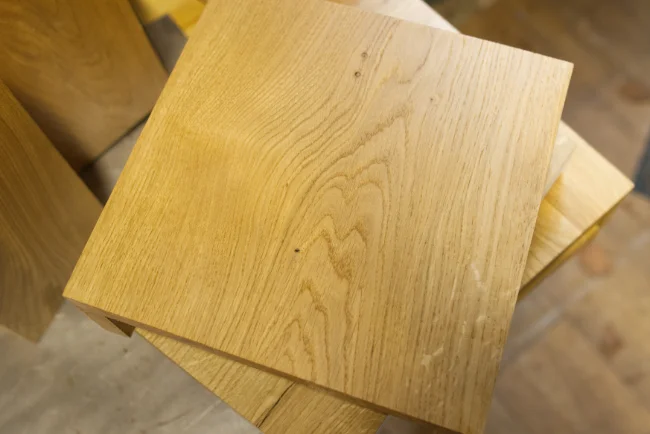
The characteristic curved forms of cathedral grain
How does it form?
Cathedral grain appears when the tree is milled with the growth rings. This is especially the case with flat-sawn wood. When you look at such a flat-sawn plank from the front, you see those characteristic curved patterns.
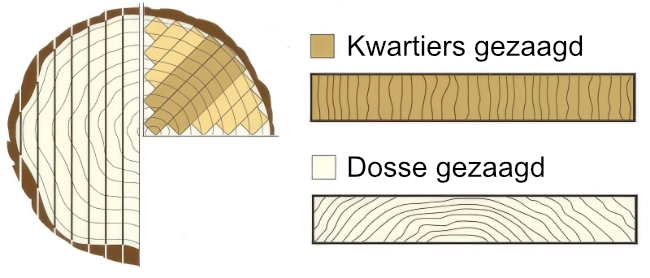
Flat-sawn versus rift-sawn
Figure: the gleaming secret of oak
To explain what “figure” is in oak, we need to start at the beginning—with the tree.
There are bundles of cells that run horizontally through the trunk, from the heartwood to the bark. In the photograph of an oak tree’s cross-section, you can clearly see them as white stripes. We call these the medullary rays (or wood rays). They transport nutrients across the tree, from the heartwood to the bark. Not every wood has such distinct rays; oak is one that does.
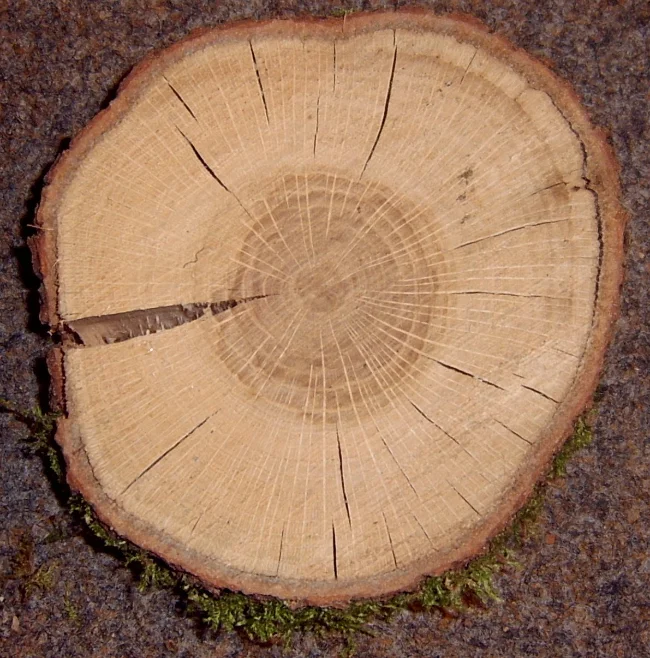
Medullary rays visible in the end grain of an oak log—from heartwood to bark
When does figure appear?
Figure is the cross-section of medullary rays. The figure becomes visible when the medullary rays run across the surface of a board. With rift-sawn wood, for instance, both the saw cut and the medullary ray run parallel to each other (from heartwood to bark), so the figure appears elongated. If the medullary ray runs more perpendicular to the saw cut, shorter figure appears.
When figure appears, it adds something special: a subtle shimmer that shifts with the light. These are gleaming, almost iridescent planes—a liveliness that keeps drawing your eye. Move the wood back and forth in the light, and you’ll see the reflective effect.
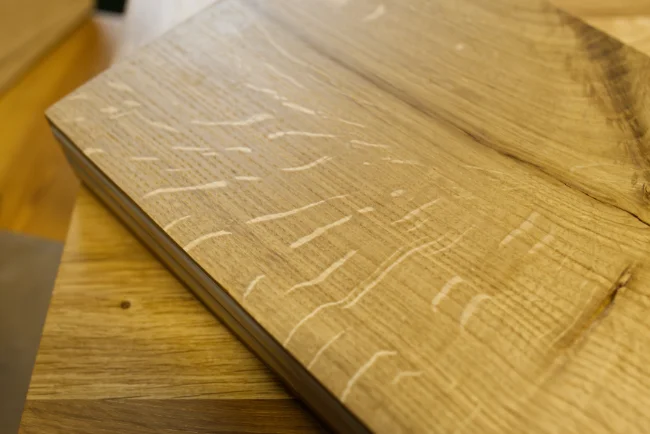
The subtle shimmer of figure in oak
Both patterns in one lamp
In my studio, I work with oak as it comes. I don’t specifically select for cathedral grain or figure. So the patterns vary throughout my collection. One lamp shows rich cathedral grain, another gleaming figure. And if you look closely, you’ll actually find both in every piece of oak—because my oak always follows the growth rings at least somewhat, and always has medullary rays running through it.
That’s exactly what makes wood so special. It’s not a printed pattern, not a decoration you choose from a catalog. It’s a tree’s history, captured in fibers and rings, revealed by the saw and brought to life by oil.
See with fresh eyes
The next time you look at a Hupacha lamp, I invite you to pause for a moment. Look at the grain. Follow the lines. Do you see the arches of a cathedral? Or do you catch the shimmer of figure as light plays across it?
Each piece of wood needed decades to grow. That time, those seasons, that life—it’s all there in the grain you see now. And that’s what makes every lamp unique. Not because I decide it, but because nature has determined it.
Curious about my oak?
Explore the collection and discover the magic of oak in every lamp.
Explore the oak lamps